Content & Photos © Bill Schmoker unless noted otherwise. Thanks for visiting- drop me a comment!

Friday, March 26, 2010

Dipping on Ptarmigan


Last weekend I led a Denver Field Ornithologists trip in search of White-tailed Ptarmigan in the Indian Peaks Wilderness west of Boulder. This was a snowshoe birding trip, and with a foot of fresh snow they were absolutely required to get around. We 'shoed up to treeline, ticking only 3 birds (Mountain Chickadee, Golden-crowned Kinglet, and Red-breasted Nuthatch) along the 2-mile climb through the subalpine forest, but we were dazzled with the snow-draped spruces, firs, and pines. As we got glimpses of the Indian Peaks through the trees I knew we were going to face harsh conditions above treeline, though, as wraiths of snow were being whipped high above the ridge lines by strong winds. Sure enough, as we overtopped the dam at Left Hand Reservoir, we were blasted by gusts of 25-30 mph. I brought along a Kestrel weather meter that registered 6.8° F. At that combo the wind chill is around -15° F. More importantly, White-tailed Ptarmigan deal with harsh conditions in an efficient way, staying cozy by scrunching down into the snow and letting it drift over them. Without tracks to indicate areas of recent activity or birds above the surface to scan for our odds were pretty slim but we tried for a while anyway, snowshoeing around the stunted willow groves were they winter, dining on wind-exposed buds. After a valiant effort we decided that keeping all of our fingers and toes was more important and headed back down sans ptarmigan. It was hard work for 3 species of birds but a dazzling day in the Colorado high country! Thanks to the 8 hardy birders who joined me on the quest- maybe we'll have better luck next time.

Peering up at a Golden-crowned Kinglet


Trooping Up (Last pic courtesy of Dave Alcock- that's me in front.)


Wind-whipped snow flying off Mt. Audubon


Krummholz zone


Looking back at my tracks across Left Hand Reservoir. Two specks in the distance are Ed and Dave who searched the longest and hardest- thanks for trying, guys!


Wind-whipped snowshoe-birders (photo by Dave Alcock- thanks again, Dave!)

Wednesday, March 17, 2010

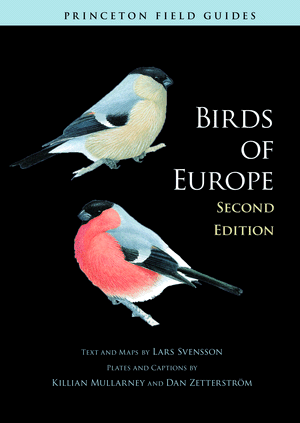
Birds of Europe, 2nd Edition


I've just received a review copy of The Birds of Europe, 2nd Edition with Text and Maps by Lars Svensson and Illustrations and Captions by Killian Mullarney and Dan Zetterström.

The first edition was widely considered to be the epitome of field guides, and the revisions found in this edition will cement its reputation as an archetype to which others will be compared.

I'd say that any serious North American birder needs this guide. I often turn to this book in reference to holarctic species that we share with Europe. For example, I think this book's treatment of Jaegers (er, Skuas seeing that it is a European guide...) surpasses anything in the N.A. guides and rivals the specialty Skuas and Jaegers guide (out of print but available as pricey used versions) by Olsen and Larsson. Then there's always the chance of vagrants from across the pond in need of ID- stint, anyone?

Anyway, I'd encourage anyone who doesn't have this guide to check it out. Here's more info from Princeton University Press, the publisher.


Since it was first published a decade ago, Birds of Europe has become the definitive field guide to the diverse birdlife found in Europe. Now this superb guide has been brought fully up to date with revised text and maps along with added illustrations. Uniquely designed for easy use in the field, this expanded edition covers all 772 species found in the region as well as 32 introduced species or variants and 118 very rare visitors. Detailed species accounts describe key identification features, voice, habitat, range, and size. More than 3,500 full-color illustrations depict every species and all major plumage variations, and color distribution maps provide breeding, wintering, and migration ranges for every species.

Complete with an introduction to each group of birds that addresses major problems of observation and identification, this new edition is the ultimate field guide to Europe's fascinating birdlife.

  • Expanded and fully updated
  • Covers all 772 species found in Europe, 32 introduced species or variants, and 118 very rare visitors
  • Features more than 3,500 color illustrations that depict every species
  • Includes detailed species accounts
  • Provides color distribution maps for every species
  • Color plates face text and maps for at-a-glance identification

Lars Svensson is one of Europe's foremost field ornithologists. Dan Zetterström and Killian Mullarney are two of Europe's leading bird artists.

Reviews:

"The richest and the most comprehensive of the current guides."--Times (London)

"If you are birding in Europe, you must have this guide. It should be on the shelf of many North American bird watchers, especially those who live along the Atlantic coast, where many European birds are found. It should also be in the library of anyone who collects field guides, if for no reason other than you can occasionally take it down and be reminded of what is possible when art and design and purpose are treated as equal parts of a final product."--Bird Watcher's Digest

Friday, March 05, 2010

Looking Sharp!

Throughout the winter months I’ll sometimes notice that my backyard gets very quiet, devoid of the busy activity usually found around my platform and hanging feeders. Then I’ll often notice the distinctive profile of an Accipter perched in a nearby tree or on the fence. I mainly get Sharp-shinned Hawks but also sometimes see a Cooper’s Hawk lurking or actively diving into my spruce trees to bust out birds seeking sanctuary in the dense boughs. Sometimes I’ll find a scatter of feathers beneath a perch where a hunt reached a successful conclusion. I’ve found a few such piles of Eurasian Collared-Dove feathers recently- certainly not from a Sharpie but perhaps a gnarly Cooper’s? The reason I wonder is that there have been a few reliable reports of a Goshawk in my end of town this winter, raising hopes that I might someday add that big bad ‘un to the yard list.

Anyway, as I went out to fill the feeders last weekend I was accompanied by my frequent helper, Garrett. I noticed an immature Sharp-shinned Hawk hanging out in an ash tree next to our biggest blue spruce, no doubt deciding on a strategy to get at the House Sparrows and Finches deep within (earlier in the week I heard and then saw the same Sharpie deep within the spruce, playing tag with the House Sparrows.) Garrett didn’t see the hawk and proceeded to walk almost right beneath it. Amazingly the Sharpie didn’t fly away despite the proximity of a pre-schooler cavorting below. I took this as a sign to go get my camera and ended up with some nice close-ups as the bird was remarkably tolerant of close approach.

Raptors are smart cookies and I think that the Sharpie was hoping we’d flush out a sparrow or finch. I went around the fence to the patch of open space behind our yard to get some pics of its belly side and heard birds nervously calling and shifting around in the brush pile I’ve made there, which really drew the Sharpie’s attention. The next thing I knew, the hawk flew seemingly right at my head but passed just overhead. It must have been a false start because it broke off any chase, swooped up and landed in the cottonwood. A few minutes later, though, a House Sparrow made a dash from the brush pile and the Sharpie pursued it out of sight around a corner, gaining fast. No wonder Bill Thompson III calls these birds Death Rockets!

Thursday, February 25, 2010

Snow Light

We've had a relatively cold, snowy winter around here (Colorado's Northern Front Range) so far, which has made for some nice raptor photo opps. The combination of fresh snow on the ground and sunshine really lights up the underside of soaring birds, which can otherwise be tricky to photograph well in bright skies. So with the opportunity nearly unlimited free bounce-light I recently went out for a few hours on a favorite local loop in northern Boulder County to photograph raptors.

One pic I was very pleased with is this female American Kestrel. They aren't especially rare 'round here but are so small and fast I find it hard to get anything but perched or distant flight shots. This time, though, I got a keeper flight snap along with a good portrait!

I also like our western Red-tailed Hawks, however common. Amazing how much the tail color changes when lit from below vs. on top:

The highlight was revisiting an adult light-morph Harlan's Hawk that is back in the area for at least its 3rd consecutive winter. I've blogged on the bird each of the two previous winters- see here (the 1st time I found the bird) and here (last winter's best shots.)

In the January issue of Colorado Birds, Jerry Liguori (if you don't have his Hawks From Every Angle you need it!) and I published an article detailing his amazing photographic re-detection of this bird in Alaska a couple of months after I photographed it near Hygiene, Colorado last winter. Check out the composite cover shot below- the top image is Jerry's from Gunsight Mt., AK, 13 April 2009 and the bottom is mine from Hygiene, CO, 21 Feb. 2009.
This seems to be the first such detection of a normally-migrating bird over such a long distance. Other birds have been photographically re-documented as they return to territories and vagrants or aberrant birds have been photographically tracked across considerable distances in a few cases. To track a migrating bird over thousands of kilometers, however, typically involves electronic telemetry or visually tagged birds.

Tracking this bird took an amazing combination of elements. First, Red-tails are ideal for potential photographic comparisons because each individual has a unique set of plumage characteristics (part of the reason the group is frustrating to beginners- few look just like the ones depicted in field guides and some look totally different!) Secondly, light Harlan's Hawks are pretty rare and get the attention of birders and bird photographers more than the more commonly-occurring "flavors." Third, I had the good fortune of sharing my earlier pics with Jerry who gave me feedback at the time. The most amazing part is that Jerry not only photographed the same bird but that he made the connection to the photos I had sent him months earlier. He told me that he saw hundreds of migrating Red-tails (both Western and Harlan's) over several days on his trip to Alaska so he really picked the needle out of the haystack. Below is a bit higher res version of the composite for your perusal with the AK photo on the left and the CO pic on the right.

Sunday, February 14, 2010

Boxing

One way I get a little extra birding mileage during the slow winter months is to build and put up bird boxes when I get the chance. Luckily, a birding buddy of mine has access to a great property that seemed in need of some boxes so at the onset of winter I began cobbling a selection together. The first one I made (with the help of my assistant Garrett) was a Barn Owl box.

An open-sided pole barn on the property had a Barn Owl sticking around from summer but its perch in the barn was fairly unprotected, simply on top of a pole up in the rafters. Still, it was obvious that it was a long-standing roost based on the whitewash and pellet pile below the pole.

We popped the box up next to its preferred perch in late November and the owl took up residence immediately. It has stayed all winter- pretty cool & kind of unusual for Colorado's northern Front Range! (Or not so cool if you are a nearby mouse or the Northern Flicker it somehow managed to pluck and eat, judging by the orange feathers beneath the box we saw last Friday...) The box has a thin open slot at the bottom that allows pellets to get pushed out (the pattern was designed for commercial pellet collectors who supply the educational market), but it also has the benefit of letting us sneak a peak to see if Barney is home without flushing the owl. My friend John Barr took this pic looking up at the box and you can see a thin slice of Barn Owl through the slot (that's the bill in the middle and the bottom corners of the facial disc angling up from each side of the bill.)

Another round of mid-winter box-building produced some Tree Swallow abodes and a Kestrel Box that we put on a nice cottonwood overlooking a big hay meadow.


Finally, I built a couple of Wood Duck boxes a few weeks ago and on Friday I took advantage of the remaining decent ice to put them up in some likely looking ponds (former gravel pits) near a wooded creek. The ice makes a great platform for pounding in the post and mounting the box- a lot easier than trying the job from a boat. I hope the Wood Ducks like them as much as the Barn Owl likes his box!! Thanks to John Barr for snapping the pics (and for letting me bird with him on this great spread!)

Tuesday, January 12, 2010

Ice, Ice, Baby!

I had the privilege of visiting friends Chris Wood and Jessie Barry in their Upstate NY haunts over my winter break. Our exploits crossed the border into Canada as well, partly for the birding there (5-figure gulls in Niagra and a Barnacle Goose in Grimsby, for example.) The other reason is that the closest American Airlines could get me to my intended destination (Rochester, NY) within 3 days of my departure from Denver was Toronto...

Anyway, we had the good fortune to base ourselves at Jessie's parents' house on the south shore of Lake Ontario for a couple of days (Thanks, Jim & Liz!!) They have the ultimate lake-watching setup- picture windows facing the lake and an awesome rail-mounted, top-down scope mount right at the window. A strong arctic cold front blasted in on our first night, and we did some serious pajama birding for a while with the comforts of hot coffee and a hot fireplace nearby. A decent lake-watch list developed including scads of Long-tailed Ducks, White-winged Scoters, and Red-breasted Mergansers flying by in adjustment to the new weather conditions.
Pajama birding at its finest...

Eventually, however, we sallied out into the gnarly weather (temps in the low teens and winds in the high 20s and 30s.) More good birds were found, but to me some of the most impressive sights were the ice formations that were plastered on the breakwaters and navigation lights at the mouths of rivers.

Winter birding on Lake Ontario: Only serious, well-dressed birders need apply.


Fantasmagorical ice at Charlotte Lighthouse (Mouth of Genesee River.) A miracle sunbeam hit the lighthouse for a minute or two- the picture doesn't begin to do it justice...


More wicked ice at the Irondequoit light

Oh, and there were birds around, too. I'm usually lucky to see a single Long-tailed Duck each year in Colorado, so I was pretty geeked to see thousands of them on the lake. The light was rough and many of the birds were distant and wary, but I still vastly improved my photo stock of this species.