




 Peering up at a Golden-crowned Kinglet


 Trooping Up (Last pic courtesy of Dave Alcock- that's me in front.)
 Wind-whipped snow flying off Mt. Audubon
 Krummholz zone
 Looking back at my tracks across Left Hand Reservoir. Two specks in the distance are Ed and Dave who searched the longest and hardest- thanks for trying, guys!
 Wind-whipped snowshoe-birders (photo by Dave Alcock- thanks again, Dave!)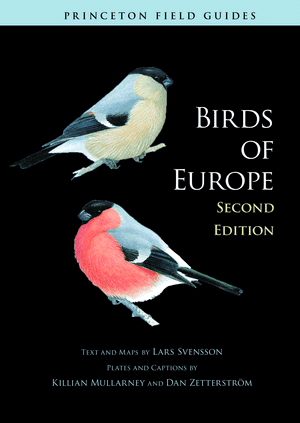
Since it was first published a decade ago, Birds of Europe has become the definitive field guide to the diverse birdlife found in Europe. Now this superb guide has been brought fully up to date with revised text and maps along with added illustrations. Uniquely designed for easy use in the field, this expanded edition covers all 772 species found in the region as well as 32 introduced species or variants and 118 very rare visitors. Detailed species accounts describe key identification features, voice, habitat, range, and size. More than 3,500 full-color illustrations depict every species and all major plumage variations, and color distribution maps provide breeding, wintering, and migration ranges for every species. Complete with an introduction to each group of birds that addresses major problems of observation and identification, this new edition is the ultimate field guide to Europe's fascinating birdlife.
Lars Svensson is one of Europe's foremost field ornithologists. Dan Zetterström and Killian Mullarney are two of Europe's leading bird artists. "The richest and the most comprehensive of the current guides."--Times (London) "If you are birding in Europe, you must have this guide. It should be on the shelf of many North American bird watchers, especially those who live along the Atlantic coast, where many European birds are found. It should also be in the library of anyone who collects field guides, if for no reason other than you can occasionally take it down and be reminded of what is possible when art and design and purpose are treated as equal parts of a final product."--Bird Watcher's Digest |


Anyway, as I went out to fill the feeders last weekend I was accompanied by my frequent helper, Garrett. I noticed an immature Sharp-shinned Hawk hanging out in an ash tree next to our biggest blue spruce, no doubt deciding on a strategy to get at the House Sparrows and Finches deep within (earlier in the week I heard and then saw the same Sharpie deep within the spruce, playing tag with the House Sparrows.) Garrett didn’t see the hawk and proceeded to walk almost right beneath it. Amazingly the Sharpie didn’t fly away despite the proximity of a pre-schooler cavorting below. I took this as a sign to go get my camera and ended up with some nice close-ups as the bird was remarkably tolerant of close approach.

Raptors are smart cookies and I think that the Sharpie was hoping we’d flush out a sparrow or finch. I went around the fence to the patch of open space behind our yard to get some pics of its belly side and heard birds nervously calling and shifting around in the brush pile I’ve made there, which really drew the Sharpie’s attention. The next thing I knew, the hawk flew seemingly right at my head but passed just overhead. It must have been a false start because it broke off any chase, swooped up and landed in the cottonwood. A few minutes later, though, a House Sparrow made a dash from the brush pile and the Sharpie pursued it out of sight around a corner, gaining fast. No wonder Bill Thompson III calls these birds Death Rockets!


 This seems to be the first such detection of a normally-migrating bird over such a long distance. Other birds have been photographically re-documented as they return to territories and vagrants or aberrant birds have been photographically tracked across considerable distances in a few cases. To track a migrating bird over thousands of kilometers, however, typically involves electronic telemetry or visually tagged birds.

 One way I get a little extra birding mileage during the slow winter months is to build and put up bird boxes when I get the chance. Luckily, a birding buddy of mine has access to a great property that seemed in need of some boxes so at the onset of winter I began cobbling a selection together. The first one I made (with the help of my assistant Garrett) was a Barn Owl box.

 The box has a thin open slot at the bottom that allows pellets to get pushed out (the pattern was designed for commercial pellet collectors who supply the educational market), but it also has the benefit of letting us sneak a peak to see if Barney is home without flushing the owl. My friend John Barr took this pic looking up at the box and you can see a thin slice of Barn Owl through the slot (that's the bill in the middle and the bottom corners of the facial disc angling up from each side of the bill.)


 Posts
All Comments
Posts
All Comments


