Another fantastic bird graced Boulder County this week (on the heels of our recent Louisiana Waterthrush.) I knew something was up when I heard my cell phone ringing throughout my 1st and 2nd period classes yesterday. A quick glance at my email showed that Ted Floyd had found a Ruff(!!!) in the snowstorm at nearby Boulder Reservoir. I have a planning period 3rd hour, so I grabbed my jacket and hit the road for the 'Rez, 10 minutes away. I didn't have bins, scope, or camera, but I gambled that folks would be there and sure enough, a few buddies had the bird in their scopes. LIFER!! I made it back to school half-soaked from the blowing wet snow but with plenty of time to spare before my next class, and headed back in the evening after a stop at home to grab gear. I didn't get real close (I figure it is bad karma to flush a bird that lots of folks are still wanting to see) but at least I got these record shots. There is an interesting discussion going on about the bird's sex. While initially assumed to be a female (Reeve), Bill Maynard raises the possibility that it is a lesser-known male form known as a satellite male. These guys lurk around the lek of displaying males, sneaking in mating opportunities when they can, but they don't look like the spectacular big Ruffs. It will be interesting to see if this issue can be resolved definitively. Whatever the case, I tried again this morning before work but the winds had shifted and so had the bird- a proverbial one-day wonder.


Here's a link to an article in today's Rocky Mountain News detailing Colorado's recent ascendancy to the 7th-largest state bird list (with Brown-crested Flycatcher and Streak-backed Oriole lifting us out of a tie with Alaska and Massachusetts.) Yours truly is quoted, too- I spoke with the reporter for quite a while over a week ago. http://www.rockymountainnews.com/news/2008/apr/28/birds-eye-view-state-is-great/
I made a trip up to North Park, Colorado, heading up after work on Thursday to take advantage of a comp day I had on Friday. My main target was Greater Sage-Grouse, but North Park is full of great birding & wildlife viewing opportunities so the day was filled with photo-opps. Despite the great showing of Greater Sage-Grouse, I was hoping for a little better light (Friday Morning dawned with snow flurries), so I stuck around for another go at it Saturday morning. Leaving the hotel at 5:30, I was happy to see the moon and stars in a mostly clear sky- although it had snowed overnight it looked like a sunny morning at the lek. Another problem ended up facing me- a Golden Eagle strafed the grouse about 10 minutes before sunrise, scuttling my hopes of the warm light illuminating their choreography. Still, some of the more testosterone-crazed males came back after a while and I got some shots I liked:


 Then, somewhat to my amazement, my cell phone rang. The reason I was a bit surprised was that I didn't have coverage throughout most of the remote landscape (the day before I had to drive to a prominent high spot and park to call home for my daily check-in with the fam.) But by some stroke of luck the spot I was parked in had enough reception for my buddy Nathan to get through to me with news that a Louisiana Waterthrush was being seen in Longmont, at a spot only about 5 minutes from my house. Having got my grouse shots, I decided to pack it in and head home- only a few hours earlier than I would have, anyway. The two passes I had to cross (Willow Creek and Berthoud) were in the midst of solid snow showers, and the going was kind of slow over the snowpacked surface, but things kept moving and about 4 hours later I was pulling up to the waterthrush spot. I was relieved to see my friend Rachel there, waving me down to where a couple of observers had the bird. I'd only seen the species once before, putting together the pieces of a bird in heavy cover on S. Padre Island, Texas. This one was mostly hanging out in a culvert, feeding on rocky gravel bars in the middle of Lefthand Creek and occasionally sallying out to work the banks above and below the bridge where it usually hung out. To photograph the bird (ABA photo tick #575!) in the culvert I had to mount up a flash and use a Better Beamer to reach it, but my favorite shots came as I anticipated the bird's movement back towards the bridge and lay on my belly above a cut bank, catching it on the branches reaching into the stream and on the log. By this morning the bird was gone- glad I got the news and could get there post-haste.


Well, I'm back in one piece from Florida and starting to feel like I'm settling in back at home (the feeling may be complete with the snowfall forecast for tonight...) Even though my head finally hit my pillow at 1:15 am Monday morning, the buzz of new birds in new places kept me from feeling exhausted (sleepy-tired, yes, but wiped-out, no!)
I had never birded central Florida before, so I needed a lot of the specialty birds there. My Florida-based buddy, Jeff Bouton, picked me up in Orlando for a whirlwind day of target birding before we headed up to St. Augustine for the Florida Birding & Fotofest. I ended up with 5 life birds that day, and picked up another one or two (depending on who's list of accepted birds you are looking at) at the festival.
Of course, one bigshot bird there is the Florida Scrub-Jay, the state's only endemic bird species. I was getting nervous because our Scrub-Jay stops were late in the day, and we missed the bird at the first couple of places we tried. Not to worry, though- at Merritt Island NWR, on the aptly-named Scrub Ridge Trail, the birds arrived. The first individual flew in to Jeff's mimicked contact call, giving me my life look and a couple of quick pics before it flew off again. I would have been happy with that, but about 2/3 of the way around the trail a group of 4 or 5 birds came in, apparently expecting handouts. They loitered near us for a while before one, apparently out of patience with our lack of peanuts, landed on my head. Needless to say, I got some acceptable shots of this species (thanks, Jeff, for snapping the bird on my hat!)


 When we were set up at the Leica booth at the festival, Jeff overheard someone talking about a Brown Booby they had seen at the public fishing pier at St. Augustine. Hello- that might be of interest to a lot of out-of-towners!!! So we made the trip, bought our 50-cent tickets to the pier, and went out to greet the bird. Apparently it has been around since at least last November but it hadn't been reported on any Florida lists for a while. Some of the regulars on the pier said it had disappeared for a few months but had been back for a month or so. It is getting handouts on the pier but it can fly and heads out to fish, but is back on its little stretch of railing behind a small white structure every evening. We enticed it away from the distracting building with a discarded scrap of bait squid to get clear shots of it. Thanks again, Jeff, for snapping my portrait- it isn't every day that I get to pose with a lifer!

 This shot is looking into the sun but you can see me and another photographer down the rail snapping pics of the bird...
 And here's a reciprocal shot of Jeff shooting the booby and me as I'm shooting the booby and him... better look out or we'll warp time and space into a mini black hole centered at St. Augustine or something!


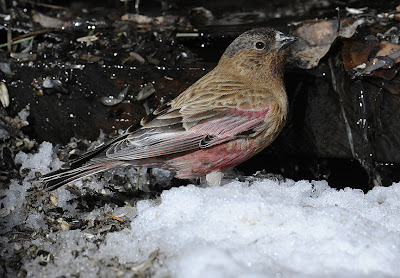
I paid a visit to Allenspark yesterday, hoping to shake hands again with rosy-finches. It is still wintry up there but the snow is melting fast. The weather was nice, meaning far fewer rosies then would be expected in bad weather, but in trade the road up was dry and sun was shining on the birds that did visit. The place was overrun with juncos (crazily, every form of Dark-eyed except for the locally breeding Gray-headed), and all three rosies eventually came and went. Most of the pinkies were Brown-capped Rosy-Finches, a species almost endemic to Colorado (although their range spills over a bit into northern New Mexico in the winter and a few breed in southern Wyoming.) They are looking really sharp now- their colors are vibrant and their beaks have gone to the breeding black color (they are yellow for much of the winter.) Usually the birds at the Fawnbrook Inn are hard to photograph well as they stay high in the aspens or fly to a platform feeder up on a deck of the inn where they are hard to see well, but one came down and perched fairly low in front of the restaurant, delighting a tour group with WINGS and giving me a photo opp, sitting on the ground to shoot through a branch-free corridor.
 When the tour group moved on I chummed a snowy part of the yard with some seed that I keep in the car for such occasions. The gambit worked wonderfully, not only providing boucoup Junco photo opps (more on these later), but several rosies came in to partake. I sat quietly in the muddy parking lot at the edge of the yard to shoot the birds at eye level as they traipsed around in the snow, got drinks from a trickle of snowmelt, or perched on low branches as they came and went. While a few Gray-crowned Rosy-Finches were up in the trees, most of the birds coming to the ground were Brown-capped Rosies.


 I noticed that one of the Brown-capped Rosy-finches had color bands on its legs. I know some local banders who work with rosies, and a few inquiries turned up the story of the bird. My friend Nancy Gobris banded it ("PJXY"; P=pink, J=jet (black), X=aluminum, Y=yellow) as a second-year male at her house above Estes Park, Colorado (over the hill from Allenspark) on 14 April 2007. Cool to get a band recovery without re-capturing the bird or finding it dead somewhere...

 The bird I was most excited to photograph, though, was this immature male Black Rosy-Finch. We don't get many black rosies coming through Boulder County, but it seems like the best bet for them is later in the season. A few spanking dark adult males were around, as were some frosted-looking females, but this guy was the only one to come down right in front of me. Neat bird, but it will get even blacker as an adult, and all of the washed-out areas will get to be a more vivid pink.


 Then, somewhat to my amazement, my cell phone rang. The reason I was a bit surprised was that I didn't have coverage throughout most of the remote landscape (the day before I had to drive to a prominent high spot and park to call home for my daily check-in with the fam.) But by some stroke of luck the spot I was parked in had enough reception for my buddy Nathan to get through to me with news that a Louisiana Waterthrush was being seen in Longmont, at a spot only about 5 minutes from my house. Having got my grouse shots, I decided to pack it in and head home- only a few hours earlier than I would have, anyway. The two passes I had to cross (Willow Creek and Berthoud) were in the midst of solid snow showers, and the going was kind of slow over the snowpacked surface, but things kept moving and about 4 hours later I was pulling up to the waterthrush spot. I was relieved to see my friend Rachel there, waving me down to where a couple of observers had the bird. I'd only seen the species once before, putting together the pieces of a bird in heavy cover on S. Padre Island, Texas. This one was mostly hanging out in a culvert, feeding on rocky gravel bars in the middle of Lefthand Creek and occasionally sallying out to work the banks above and below the bridge where it usually hung out. To photograph the bird (ABA photo tick #575!) in the culvert I had to mount up a flash and use a Better Beamer to reach it, but my favorite shots came as I anticipated the bird's movement back towards the bridge and lay on my belly above a cut bank, catching it on the branches reaching into the stream and on the log. By this morning the bird was gone- glad I got the news and could get there post-haste.


 In the next shot, the bird turned its head just right to see the long, hooked bill that it uses to extract snails from their shells. SNKIs will eat other prey, but rely on snails for their primary sustenance.
 There was also a territorial pair of adults patrolling around the marshy stuff to the north of Brinson Park. Here's a sequence of the male swinging up to confront an Osprey that made the mistake of flying over their airspace- the Osprey is dropping its talons defensively as the kite comes up from below.


 In a case of turnabout being fair play, Boat-tailed Grackles took exception to the male Snail Kite perching within their comfort zone- check out the dark dive-bombing blurs in this digi-vid:


 When we were set up at the Leica booth at the festival, Jeff overheard someone talking about a Brown Booby they had seen at the public fishing pier at St. Augustine. Hello- that might be of interest to a lot of out-of-towners!!! So we made the trip, bought our 50-cent tickets to the pier, and went out to greet the bird. Apparently it has been around since at least last November but it hadn't been reported on any Florida lists for a while. Some of the regulars on the pier said it had disappeared for a few months but had been back for a month or so. It is getting handouts on the pier but it can fly and heads out to fish, but is back on its little stretch of railing behind a small white structure every evening. We enticed it away from the distracting building with a discarded scrap of bait squid to get clear shots of it. Thanks again, Jeff, for snapping my portrait- it isn't every day that I get to pose with a lifer!


 And here's a reciprocal shot of Jeff shooting the booby and me as I'm shooting the booby and him... better look out or we'll warp time and space into a mini black hole centered at St. Augustine or something!


 I'm blogging on the go this afternoon- waiting in Denver International Airport as my MacBook sips the free wireless. I'm off to the Florida Birding and Fotofest (their spelling, not mine.) If you are attending, drop by the Leica booth to say hi or check out my workshop on Sunday. A few weeks ago I took another great trip, visiting Nebraska for cranes and chickens. Yeah, I know non-birders think that I must be insane to purposefully go from Colorado to Nebraska for part of my spring break, but it was a great trip and I ran about 2500 shutter cycles on my new D300. So far, so great!! Thanks to the Denver Field Ornithologists and trip leader Alison Hilf for putting it all together. As expected, the congregation of hundreds of thousands of Sandhill Cranes at the Rowe Sanctuary was mind-blowing. It is a little harder to get close-up shots there than at Bosque del Apache in New Mexico, but the river scenery and sunrise/sunset light was fabulous.


 Oop- plane's boarding. That's all for now- see 'ya in Florida!

 When the tour group moved on I chummed a snowy part of the yard with some seed that I keep in the car for such occasions. The gambit worked wonderfully, not only providing boucoup Junco photo opps (more on these later), but several rosies came in to partake. I sat quietly in the muddy parking lot at the edge of the yard to shoot the birds at eye level as they traipsed around in the snow, got drinks from a trickle of snowmelt, or perched on low branches as they came and went. While a few Gray-crowned Rosy-Finches were up in the trees, most of the birds coming to the ground were Brown-capped Rosies.


 I noticed that one of the Brown-capped Rosy-finches had color bands on its legs. I know some local banders who work with rosies, and a few inquiries turned up the story of the bird. My friend Nancy Gobris banded it ("PJXY"; P=pink, J=jet (black), X=aluminum, Y=yellow) as a second-year male at her house above Estes Park, Colorado (over the hill from Allenspark) on 14 April 2007. Cool to get a band recovery without re-capturing the bird or finding it dead somewhere...

 The bird I was most excited to photograph, though, was this immature male Black Rosy-Finch. We don't get many black rosies coming through Boulder County, but it seems like the best bet for them is later in the season. A few spanking dark adult males were around, as were some frosted-looking females, but this guy was the only one to come down right in front of me. Neat bird, but it will get even blacker as an adult, and all of the washed-out areas will get to be a more vivid pink.


 Posts


