Content & Photos © Bill Schmoker unless noted otherwise. Thanks for visiting- drop me a comment!

Saturday, January 01, 2011

More Snow Light

> Raptors appeal to a wide spectrum of birders and nature loves like few other groups of birds. But their habit of perching high in trees or power poles and flying overhead can make photographing them challenging- they often have bright skies behind them that contribute to very dark images of the birds. Your eye & brain combination is much more forgiving than a digital camera sensor, which is why the bird that looked fine in your bins may look like a dark silhouette in your photos. You can play with exposure compensation or waiting for the right light (sunrise and sunset light from behind is quite nice) but if you live in northern latitudes, get out on a sunny day when there is snow on the ground. The snow acts like a big reflector, bouncing light up from underneath the birds. This helps illuminate raptors from below, showing features otherwise lost to underexposure on birds against bright skies. Portrait photographers sometimes use basically the same technique using portable reflectors to bounce sunlight at their models as an alternative to electronic flashes. This is especially helpful on dark raptors like eagles or dark-morph buteos, but works with about any raptor you find on a sunny day with snow on the ground. As a word of caution, light-morph raptors can look really pale in snow light- I've seen light Red-tailed Hawks mistakenly ID'd as Ferruginous Hawks in these conditions, for example, because they look so bright underneath in the bounced light.

We've had a notably dry, warm winter up to this week in Colorado's Northern Front Range where I reside. But we finally got significant snow a couple of days ago, followed by a sunny cold day today. Having the day off, I headed out to drive a nearby route I know can be productive for wintering raptors. One bird I was happy to find was this light-morph adult Harlan's Red-tailed Hawk. It is back for its 4th winter in the same wintering territory, showing the site fidelity of these birds. More amazingly, Jerry Liguori (author of Hawks From Every Angle: How To Identify Raptors in Flight and the upcoming Hawks at a Distance: Identification of Migrant Raptors) photographed the same bird in migration to its Alaskan breeding grounds in the spring of 2009. Feather-by-feather analysis of flight photos from Colorado & Alaska clearly established it was the same bird and we co-authored an article documenting the long distance photo-recovery in Colorado Birds Vol. 44 No. 1, Jan. 2010 (PDF here). It was great seeing this old friend again today and snapping it in the great snow light!


Nearby was another adult Harlan's Hawk- this one more typically dark (perhaps a dark-intermediate morph per Brian Wheeler's Raptors of Western North America.) It was perched nearly over the road and I photographed it leaning out my vehicle window. The snow light really brings out the feather detail in the dark body!


I finished my tour with a raptor that took my breath away- an adult male rufous-morph Ferruginous Hawk. (Rufous individuals with gray heads are likely males vs. females with brown heads per Brian Wheeler's Raptors of Western North America.) This bird wasn't as cooperative as the above Harlan's- it perched in a twiggy cottonwood tree and then flew between me and the sun. On a normal day the flight images would probably have been unsalvageable, but with the snow light and a bit of shadow highlighting in post-processing I could bring up the amazingly rich dark rufous tones of this bird. Look at the gape- that guy is made to gulp large prey like prairie dogs & jack rabbits with a minimum of shredding! I hope you enjoy the images and get the chance to try birding & photographing raptors with snow light sometime this winter.


Thursday, September 30, 2010

New Nightjars Book

I was pretty tickled to have a new bird book from Princeton University Press waiting for me at home when I returned from the Arctic Ocean- Nightjars, Potoos, Frogmouths, Oilbird, and Owlet-nightjars of the World! What a cool tome about an awesome group of birds. The book has something for about any birder, as representatives of the Family Caprimulgiformes occur on every continent except for Antarctica. Each species (135 in all) is represented with lavish multi-page spreads of detailed maps and insanely good photos- makes me feel pretty deficient in my nightjar stock! Plus, proceeds from the book's sale support BirdLife International's Preventing Extinctions Programme. 7 nightjars and one owlet-nightjar are on the conservation effort's list including the critically endangered Jamaican Poorwill (possibly extinct, known with certainty from museum specimens collected prior to 1860), Puerto Rican Whip-poor-will, and New Caledonian Owlet-nightjar (last reported sighting in 1998.)

In addition to the species accounts, the beginning of the book has sections about the distribution, plumage & structure, general biology, and taxonomy of this unique bird family. The book is ahead of the curve with the AOU's recently-split Mexican Whip-poor-will receiving a full species account. Another nice touch I'd like to see in more specialty guides is the appendix listing alternative English names for the species- quite entertaining to see some of the other handles for these birds! As I look through the book I realize the paucity of my personal checklist in this department and how I hope to see many of these amazing birds eventually. Thanks to Princeton University Press for the opportunity to at least experience these birds vicariously!

Saturday, September 25, 2010

Air Time

Hey folks- thanks for following along on my PolarTREC expedition. I never thought I'd do a daily blog post for 5 weeks but it was a fantastic experience! I've got to get some bird pics summarized to post here, but in the meantime I'd like to mention an upcoming radio interview I did from my 6th-period class last week. It will air tonight in LA, tomorrow in the Boulder area, and will be online Monday. Check it out! Boomer Alley Radio's "Explorers Show" will air on Sat 10/9 at 7p PT in LA on kfwb.com, Sun 10/10 at 4 pm MT on our local radio station AM 1060 in Longmont/Denver/Boulder and across the state on Radio Colorado Network's other stations. The show will be podcast on http://boomeralleyradio.com and iTunes by Monday, Columbus Day (and possibly as early as Sunday.) Meanwhile, here are a few pics to tide you over (birds to come later..)

Thursday, July 29, 2010

Digi-oding

Well, I'm packed and ready to head to the airport early tomorrow morning, Alaska-bound for my PolarTREC expedition. Follow along via the tease links above this post as I update my journals or go right to my PolarTREC page: http://www.polartrec.com/expeditions/international-continental-shelf-survey

Feeling mostly ready I decided to head out and do a little photography this morning. For a new twist I decided to try digiscoping some dragonflies at Walden Ponds in Boulder, CO. I've shot dragonflies with a telephoto and with a macro but this was my first serious attempt at digiscoping them. I'm using my Nikon EDG (65mm angled model) and a camera that is new to digiscoping for me- the Panasonic DMC-ZS7. I got the Panasonic for my trip to AK based on its all-around utility; 300mm equivalent zoom, HD video, and GPS-tagging capabilities. But I wasn't expecting it to be very good at digiscoping, as most cameras with more than 4X optical zoom don't work well. But it is pretty serviceable!

I felt mostly confident on these IDs except for the brown job which had me stymied. Luckily some of the state's best ode experts bailed me out.
Enjoy- Bill


Female Blue Dasher

Calico Pennant

Young male Autumn (or maybe Striped) Meadowhawk. Much thanks to Bill Prather & Dave Leatherman for the ID help on this one.

Halloween Pennant

Varigated Meadowhawk

Sunday, July 18, 2010

A' one, and a' two, and a' three... toes!

I led a Denver Audubon Master Birder class field trip yesterday up in the hills above Golden, Colorado to Golden Gate Canyon State Park. We saw & heard a bunch of nice montane species, and I think the highlight for everyone was tracking down a previously reported American Three-toed Woodpecker nest. Looks like this fledgling should pop out any minute, so glad we made it prior to the fledging date. It was super loud- we could hear while we were still in the woods prior to entering the clearing where its nest aspen tree was. Both parents attended the nest while we were there- this clip catches part of one of dad's visits. We also saw and heard Red-naped Sapsucker, Downy Woodpecker, and Northern Flicker while we were observing the nest and had Hairy Woodpecker earlier in the trip, so great auditory and visual woodpecker studies were had by all! The ATTW was a lifer for about half the group, which is a very gratifying thing to be a part of as a field trip leader. This cadre is about done with their year-long program and will be presenting their research projects July 26 and August 2. Break a leg, and congrats on winding up this intensive program!!

Saturday, July 10, 2010

New Titles for the Bookshelf

I thought I'd share these 5 new bird books that came out this year. What's the connection? I've got photos in them all! Check 'em out:

1)
National Geographic's Bird Coloration by Geoff Hill. Whitey the Steller's Jay rides again in this book!! From the publisher:
Why is a cardinal red or a bluebird blue? Why do some birds have plumage that is intensely colored—is it pigment, light, gender, robust health, or some combination of all four? What roles do disease, climate, and wear and tear play in this process? What does feather display signal about sexual attraction and social status? How has color camouflage evolved? These are just a few of the fascinating questions explored here in the first non-academic work on coloration and plumage, and their key role in avian life. More than 200 gorgeous photographs highlight the explanations of the essentials: what color is, ornithologically speaking; how it is produced and measured; how birds use color to attract mates and deter competitors; how birds perceive color; and how coloration varies across species by sex, season, and age. Geoff Hill guides his readers along an engaging but authoritative narrative illustrated with vivid photographs and fact-packed captions. A book conceived in the same spirit as National Geographic’s more traditional bird guides, it’s sure to appeal to serious ornithologists, recreational bird watchers, and natural history buffs alike.
2) Peterson Reference Guide to Molt in North American Birds by Steve N.G. Howell. I was very pleased to be a part of this groundbreaking book. To be a good/great birder you've got to address molt, and this book finally puts it all together in one place for N.A. birds. From the publisher:

To most observers,molt seems an overwhelming subject. But birders use many aspects of molt more than they realize--to distinguish juvenile birds from adults, to pick out an individual hummingbird from among dozens visiting a feeder, and much more. And for those whose interest goes beyond simply identifying birds, questions such as What triggers molt to start? How fast do feathers grow? and How long do they last? offer a fascinating window into the lives of birds. Put plainly, molt relates in some way to everything a bird does, including where it lives, what it eats, and how far it migrates. Here, for the first time, molt is presented for the nonscientist. Molt is very orderly and built on only four underlying strategies: simple basic, complex basic, simple alternate, and complex alternate. This book clearly lays out these strategies, relates them to aspects of life history, such as habitat and migration, and makes this important subject accessible.
3) Birdscaping for Garden Spaces: A Guide to Garden Birds and the Native Plants that Attract Them by George Adams. Birds and habitat are intricately connected and this book helps gardeners appreciate and enjoy our backyard feathered friends, and is full of ideas to make their gardens more bird-friendly. From the publisher:

Wake up to the sound of birdsong- turn your garden into a refuge for feathered friends by growing the native plants that attract them. Take a bird's eye view of your backyard with native plant and bird expert George Adams as he shows you how to create a sanctuary with year-round avian appeal. Featuring full-color photographs throughout and the author's superbly detailed illustrations. Birdscaping for Garden Spaces will help you identify resident and visiting birds and show you how and where to grow the native trees, shrubs, grasses, groundcovers, and the wildflowers that they love. Plus unique birdscaping calendars will show you how to select plants for a continuous supply of fruits, flowers and seeds to keep your bird guests happy. It's easy!
4) The Birds of Wyomong by Doug Faulkner. Finally a modern reference on the status and distribution of birds in our 10th-largest (though least populous) state. From the publisher:
Birds of Wyoming is the first comprehensive guide since 1939 to the status and distribution of Wyoming's avifauna. The book provides detailed information for over 400 bird species known to have occurred in Wyoming through 2008. Each full-page resident species account features a species photo and distribution map, while the non-resident section provides the reader insight on regular migrants and rarities. Introductory chapters authored by state experts give an indepth look at the state's ornithological history, vegetative landscapes, and avian conservation efforts. Habitat-focused sections by regional experts provide a broader view of management and conservation issues within Wyoming s dominant sagebrush, montane forest, and shortgrass prairie ecotones. Birds of Wyoming fills the niche for a state-based reference that will be useful to a wide range of professional disciplines and amateur birders. Governmental land managers as well as local and out-of-state birders alike will benefit from the easily accessible information (and literature references in most cases) in each species account.
5) The Raptors of New Mexico by Jean-Luc Cartron. A must for raptor and owl enthusiasts, particularly in the west. Even if you don't bird New Mexico the species accounts are full of good information that crosses state lines. From the publisher:

No book has ever before specifically focused on the birds of prey of New Mexico. Both Florence Bailey (1928) and J. Stokley Ligon (1961) published volumes on the birds of New Mexico, but their coverage of raptors was somewhat limited. In the ensuing years a great deal of new information has been collected on these mighty hunters' distribution, ecology, and conservation, including in New Mexico. The book begins with a history of the word 'raptor'. The order of Raptatores, or Raptores, was first used to classify birds of prey in the early nineteenth century, derived from the Latin word raptor, one who seizes by force. The text then includes the writings of thirty-seven contributing authors who relate their observations on these regal species. For example, Joe Truett recounts the following in the chapter on the Swainson's Hawk: 'From spring to fall each year at the Jornada Caves in the Jornada del Muerto, Swainson's hawks assemble daily to catch bats. The bats exit the caves - actually lava tubes - near sundown. The hawks swoop in, snatch bats from the air, and eat them on the wing'. Originally from France, Jean-Luc Cartron, has lived and worked on several continents, finding his passion in the wide-open spaces of New Mexico. He became fascinated by the birds of prey, and has studied their ecology and conservation for nearly twenty years. Raptors of New Mexico will provide readers with a comprehensive treatment of all hawks, eagles, kites, vultures, falcons, and owls breeding or wintering in New Mexico, or simply migrating through the state. This landmark study is also beautifully illustrated with more than six hundred photographs, including the work of more than one hundred photographers, and and nearly fifty species distribution maps.

Friday, July 02, 2010

Junk Birds

Well, actually really cool birds, hiding under a bunch of junk!

Last November, John Barr & I put up a Barn Owl box in a pole barn on property he has access to in Weld County, and about immediately the resident Barn Owl traded in its exposed post for the security of the box. This spring there was every sign that birds were nesting but we kept our distance to minimize disturbance. On 29 June John decided to poke his head (& camera) around the barn's side wall and was rewarded with three fledglings teed up shoulder to shoulder! I went back with him yesterday (1 July), and it seemed like we were skunked. I figured the magic window of opportunity was gone and the birds had moved out. But when I was looking at some bones in the massive pellet midden under the box, I saw a feather under a pile of junk in the corner of the barn. At first I thought it might have been molted, but when I let my eyes adjust to the darkness under an old steel barrel I started seeing more feather detail. My heart sank as I thought I was seeing part of the carcass of one of the owls. But then, by changing my angle a little I saw a facial disk with a black eye looking back at me! By peering in under the barrel, behind a culvert pipe, and under a manky cardboard box I could count all three hiding down under the junk, but only a little piece of owl at a time. I'll bet they were tired of the heat up in the barn rafters and were seeking a little cooler day roost.

Sorry for the shaky vid but you'll get the idea of what I'm talking about. For a better viewing experience open it up in YouTube and select HD.


Tuesday, June 01, 2010

Carolina Wren in Boulder


I chalked up a new Boulder County bird today thanks to my buddies Ted Floyd and David Waltman- a Carolina Wren. That completes all of the Colorado Wrens for me in Boulder County (unless/until a Cactus Wren report from this spring gets accepted to the state list...) Pretty easy twitch- I heard the bird as soon about as soon as I started listening for it, and soon had it in sight quite nearby the trail along S. Boulder Creek. I used the chase as an opportunity to try a new point-and-shoot super zoom camera I just got- a Panasonic DMC-ZS7. I mainly got the camera for my upcoming PolarTREC expedition to the Arctic Ocean, liking its built-in GPS geotagging, 400mm top end zoom equivalent, and HD video capabilities in a package the size of a deck of cards. Much to my delight, I've found it also digiscopes fairly well (some vignetting but with 12 MP plenty of room to crop) and can record sounds reasonably well, too. I'm thinking that this will be a pretty slick tool for documenting birds- exact location & time is captured by the GPS, sound and action can be obtained in the video mode, and with the zoom maxed out it has enough reach for at least record-quality pics of many birds. Above is a pic I snapped of the wren at max zoom, and below is a YouTube clip of the bird- unfortunately the visual quality is only so-so (a problem I've always had with YouTube) but the song comes through pretty well. Select the better quality vid (480p) to get the best look.


Sunday, May 30, 2010

Red Crossbill Diversity

Last weekend I led a photo trip to Hutton Lakes NWR near Laramie, WY for the Colorado Field Ornithologists annual convention. Unfortunately, conditions there were less than ideal for bird photography:


On the plus side, however, our group ran into a family group of Red Crossbills at the rest area on Highway 287 just south of the Wyoming border. The timing was perfect, as we had learned about Red Crossbill types and the evolutionary battles between crossbills and conifers from Dr. Craig Benkman the night before in his keynote address. These are Type 2 Red Crossbills, the subspecies that prefers ponderosa pines. This is the first time I've photographed a juvenile crossbill. Besides the streaky markings note the short-looking bill and tail- both still growing, I'd surmise.

Monday, May 03, 2010

Hello from Fairbanks!

I'm up in Fairbanks, Alaska for a week of professional development and training for PolarTREC (http://www.polartrec.com). I applied for this amazing program last October, found out I was a finalist a few weeks ago, had a final interview by conference call last Tuesday, and found out that I had been selected on Tuesday night! 4 days later I was on a plane to Fairbanks and here I am. This week there are 12 teachers along with me learning the ins and out of the program. In the coming year each of us will team up with a research group in the Arctic or Antarctic for a research expedition. I will be aboard the US Coast Guard cutter Healy, a polar icebreaker, from 2 August through 6 September. The ship will depart Dutch Harbor and proceed north through the Bering Sea and Bering Straight into the Arctic Ocean. The mission will primarily involve detailed mapping of the extended continental shelf in the Beaufort Sea north of Alaska and Canada, accompanied by the Canadian Coast Guard cutter Louis S. St-Laurent. In addition to bathymetry studies all sorts of other oceanographic data will be retrieved. Lots more to follow, but set a bookmark now at my PolarTREC page: http://www.polartrec.com/expeditions/international-continental-shelf-survey.

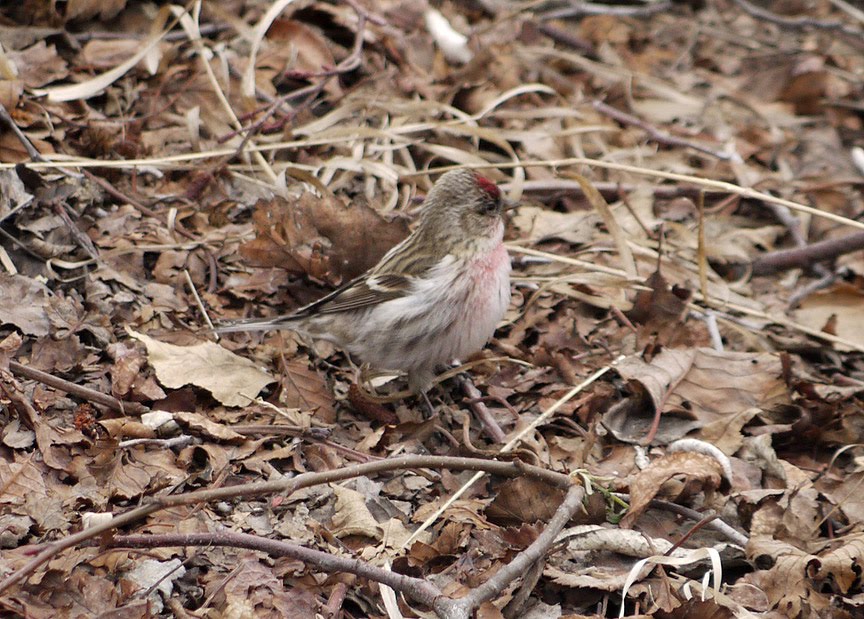
Anyway, I'm mostly in meetings all day but I did have some birding time the first morning. I walked a few blocks through downtown Fairbanks and found a nice park on the Chena River. Common Redpolls were singing all over the place, seeming to especially like birch trees and alder thickets. I was pleasantly surprised to see that the gulls whipping around were mainly Mew Gulls with an occasional Herring Gull coming up or down the river. Intermittent warbler songs that were kind of familiar resolved into Myrtle (Yellow-rumped) Warblers, looking different than the Audubon's Yellow-rumped Warblers of home with their white throats. I don't have my big camera rig with me but I am making use of the 45-200mm lens (90-400mm effective) on my Panasonic DMC-G1 which is probably what I'll be taking with me on the icebreaker. I'm missing the reach and hyper performance of my Nikon DSLR rig but that Panasonic ain't too shabby. Anyway, another busy day is promised tomorrow so I'll sign off for now with some pics I enjoyed taking.

Monday, April 26, 2010

Ready to Fledge

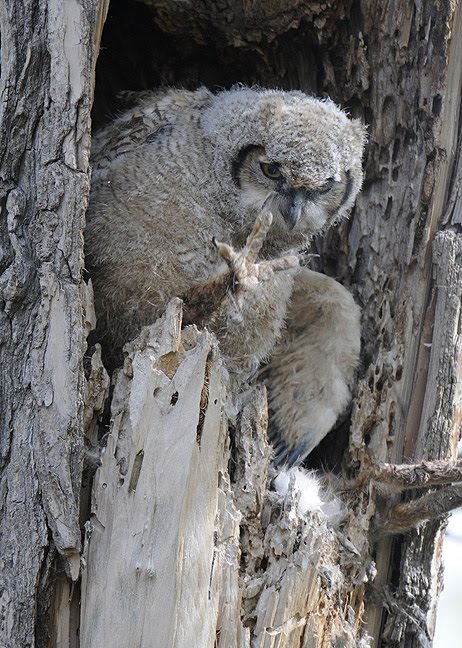
A buddy of mine recently tipped me off to a really photogenic Great Horned Owl nest along an Open Space trail NE of Boulder, CO. I scouted it on a cloudy day between deluges last week but had better light on my visit today. All of the regular joggers and walkers (with or without dogs) seemed to know about the owls & I lent several my bins for a better look while I was there. I also knew where to find a sleeping adult by other pedestrians pausing farther down the trail and peering into the woods- after I arrived it only briefly opened its eyes as a few crows cawed nearby before shutting them again. Well used to the daily stream of humanity, the urban owls (youngsters and nearby adults) were relaxed and didn't mind another loitering hominid, even one toting a long lens. The nest site, a hollow-topped cottonwood snag, afforded a neat setting without obscuring branches or too much of an upward angle. I'd say the owlets, especially the larger one that decided to do some stretching and scratching for me (my, what big talons you have), is about ready to plunge out into the world any day now. After leaving the nest, juveniles typically hang around nearby for a while as so-called "branchers", still depending on the adults to feed them. But branchers can be harder to find and photograph, so I'm glad I caught these two still in the nest!

Friday, April 09, 2010

Shake Hands with Sage

A Sage Sparrow dropped out of a recent April snowstorm 4 days ago at Lagerman Reservoir, only about 5 minutes from my SW Longmont, Colorado home. Apparently it likes it there because even though the weather has turned back to sunny and mild, it is still hanging out as of this morning. I watched it for about an hour a couple of evenings ago, sitting on a low rock along a pathway where it was foraging. I was rewarded with some stunningly close looks and at one point I wondered if it might even jump in my lap! I could hear its bill clicks and the cracking sounds of the seeds it was demolishing along with the occasional small beetle or worm for relish. It payed virtually no attention to me and the only things that alarmed it were the loud calls of nearby Killdeer and the low flyover of a pair of American Avocets, which sent it scurrying for cover under a dock at the boat ramp. Needless to say, I ended up having photo phrenzy over this engaging, obliging little chap.