Update: I'm now using the Leica C-Lux 2 camera. Other than re-positioning my cable release, everything else works the same with my digiscoping rig as described below...
Note equipment update here...
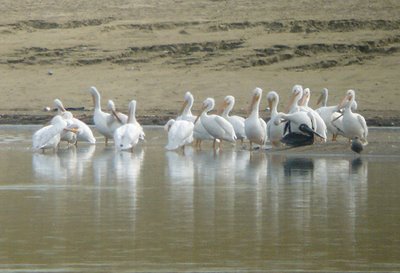
I'm feeling like I have my new digiscoping rig dialed in now. While I prefer to use my DSLR rig (Nikon D2x + 200-400mm f/4 VR, etc.) for bird photography whenever possible, there are many situations where digiscoping still rules. For example, last weekend my dad Jim & I re-found a young Brown Pelican that has been hanging around Colorado's northern Front Range all summer. The Colorado Bird Records Committee wants documentation of this rarity, a process always made easier with a photo. Unfortunately, we were seeing the bird from over 1/2 a mile away, well beyond the practical range of the DSLR. While it won't make the next cover of National Geographic, I could obtain an identifiable photo even at that extreme range with my digiscoping rig.
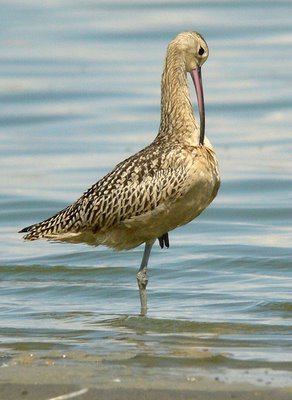
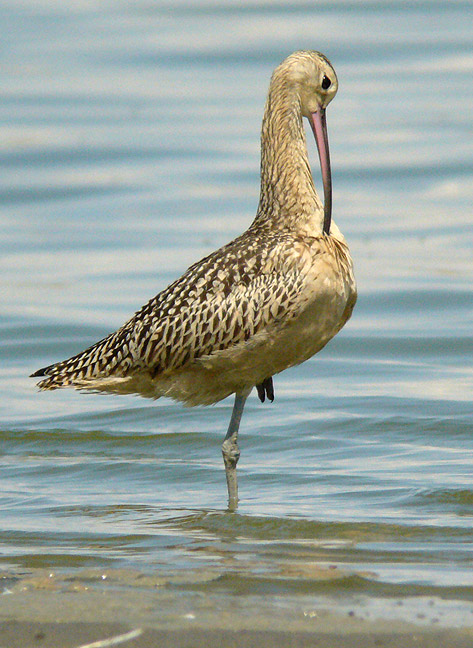
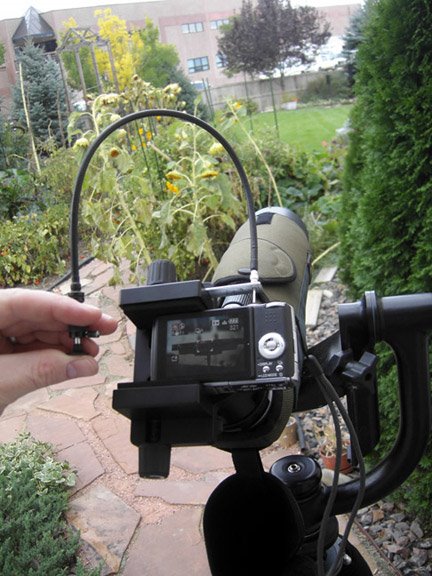
 A couple of months ago, the supportive folks at Leica Sport Optics sent me their C-Lux 1 camera and Digital Adapter 2 to hook up with my APO-Televid scopes. The camera is pretty amazing- super fast start-up & focus speed, virtually no shutter lag, no vignetting beyond the widest zoom stop (and only minor corner vignetting then...), etc. Plus the LCD screen is really wide & bright, the camera is small, the pics are sharp, battery management is really good, and so on (can you tell that I like this camera?) The adapter is a little bulky but light, very easy to set up, and goes on and off the eyepiece quickly with a one-screw lock. Basically, once you have a bird in view it is only a matter of a few seconds to have the camera mounted and shooting. Here's an example of a preening Long-billed Curlew taken with this rig (and not at 1/2 mile away- more like 70 yards.):
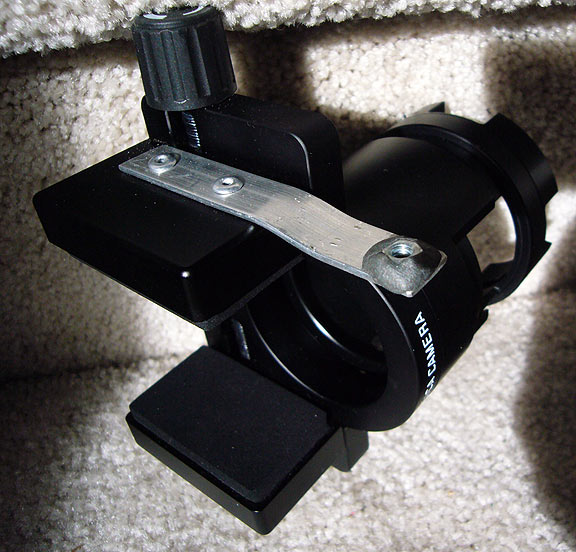
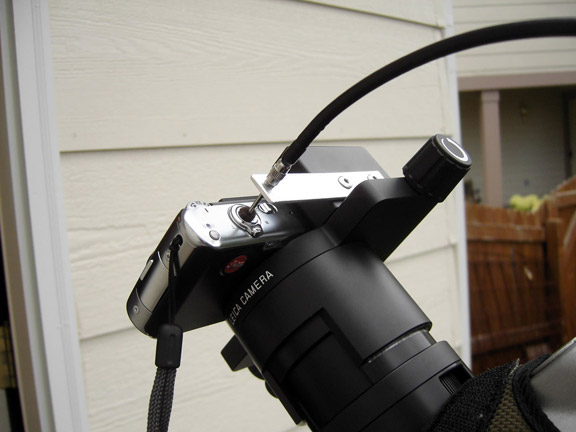
 Still, there were times when I missed the ability to fire the camera remotely. On a previous set-up, I had used a cable release bracket made by EagleEyeUK to fire my Nikon Coolpix 4500. After using the C-Lux 1 / Digital Adapter 2 rig for a while, I realized that by adding a simple aluminum extension on the top of the adapter, I could use a cable release to accomplish hands-off digiscoping (and thus minimize shake, the ultimate enemy of high-magnification photography.) To accomplish this on my new rig, I just used some thin aluminum bar stock, riveted it on the top of the adapter, and drilled a hole above the shutter to accept the cable release. I put a spot of self-adhesive felt on the shutter button so the cable release actuator wouldn't slip around, and used a small wood screw to taper the hole and have some starter threads for the cable release tip to bite into. Lastly, I slightly bent the aluminum bar down towards the shutter to compensate for the tendency of the cable release to push the thing up.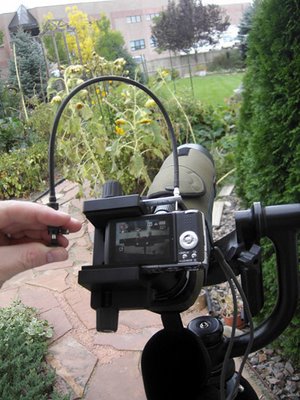
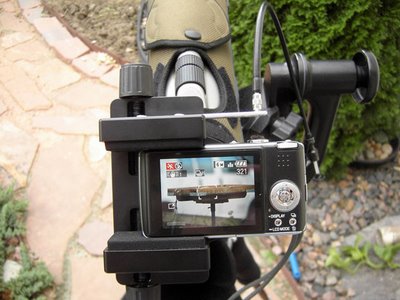
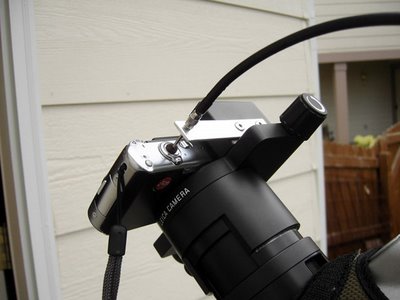
So now I'm feeling like I can worry about the bird, and not my equipment, when I'm
digiscoping- a state of photographic nirvana. Jeff
Bouton coined the term, "
digi-
schmokin'" when we were blasting pics left and right on our
World Series of Birding digiscoping big day. I like the term, capturing the gestalt of
digiscoping with confidence and success. With my new rig now dialed in, I'm confident I can get in the
digi-
schmokin' zone whenever I've got birds in my sights.


 So with the sunny day and snow on the ground, I decided to drive around some looking for raptors- the snow gives a good light bounce, lighting up the birds well from underneath. I went by a stretch of road where a dark-morph Harlan's Hawk has been frequenting, but I couldn't find it. Blazing by another intersection farther south, though, my attention was arrested by a dark, and I mean coal-black-dark, buteo on a power pole. Not one of those rufous birds (cool as they are), but a Black-Hawk-black hawk, if you get my meaning. I turned around and did a few drive-bys before finding a reasonable position to shoot out my driver's side window. The bird tolerated me for a little, and then flew up into a tall cottonwood. I drove by the bird again, parked a bit to the south, and walked up towards the bird with the sun at my back. As I got closer the bird screamed a few times and then took off. Amazingly, instead of flying away or even tangentially skirting around me, Blackie quartered towards me! I was having trouble keeping the bird centered, hoping I wouldn't blow it, wincing inwardly each time I heard the shutter fire with the image of wingtips getting cropped, but with the miracle of 5 fps bursts I managed to get some in the frame. I thought it would turn out to be a dark Harlan's Red-tailed, but it is actually a dark-morph calurus (Western subspecies). I wasn't sure if the pale, unbanded undertail was OK for calurus, but the lack of any white on the breast and the red dorsal tail surface all point to the Western subspecies. Thanks to Tony Leukering, Chris Wood, Jerry Ligouri, and Brian Wheeler for the ID confirmation. (Unsolicited plug- if you like hawks you have to get one of Brian's raptor ID books and Jerry's book, Hawks from Every Angle!) These guys are even rarer than a Harlan's around here, and these are the first good pics of this form that I've gotten. It is a very dramatic bird:

 So now I was utterly happy with my day's raptor photo tally, but I thought I'd cruise the roads north of Boulder Reservoir before heading home. Multiple prairie dog towns and abundant open space in this area makes it a pretty good winter raptor resort, and today didn't disappoint. This Prairie Falcon was keeping vigil from a power pole alongside the road. As I watched the bird it took off, flew away, but then turned parallel to the road, giving some neat side-on flight shots. About half an hour later, I re-found the bird finishing off a meal on another pole. Great news for me- sated raptors like to stay put, and can be very cooperative for photos. The mega close-up is digiscoped from almost underneath the bird. Neat way to finish off the day's shooting.










 Posts
Posts


