Content & Photos © Bill Schmoker unless noted otherwise. Thanks for visiting- drop me a comment!

Friday, January 30, 2009

Winter White

A couple of days ago I found a pleasant phone message waiting for me on my cell after work- a gentleman who had earlier attended a field trip that I co-led had found a swan on a private lake in rural Weld County, Colorado and would I like to go check it out. I had to think about it for about a millisecond but of course, I was game! Swans in Colorado are always interesting, and in mid-winter birding slowdown times it was especially exciting news. I'll admit I was expecting to see a Trumpeter Swan, which more commonly over-winters around here. But at first glance from a distance, the swan didn't appear to absolutely tower over the nearby Canada Geese. The bird was resting and bathing in a small open patch in the otherwise frozen lake, joined by a multitude of other waterfowl and coots. It was pretty calm about letting us drive pretty close, and when I got a better look in good light I could detect a very small pale spot on the lores. This, along with the size, cemented the ID as a Tundra Swan.
I enjoyed looking for some of the other marks that David Sibley has delineated in his guide and also on a supplemental swan ID page on his website- I highly suggest printing it out and tucking it into your Sibley Guide or keeping it otherwise handy. Note in particular the rounded crown (Trumpeters often have a little peak behind the eye, ala Lesser Scaup), the very narrow lores (the eyes almost look separate from the lores, especially when the bird is looking right at you), and the gently curving border between bill & forehead (a sharper V shape on Trumpeters, but this feature only reliably works on adults.)The ducks were quick to shuttle over to an adjacent pond, but the cadre of geese that the swan had joined just ambled onto the ice. The swan eventually followed suit, suddenly looking even bigger in comparison as it stood next to them. Still, when you look at some of the Trumpeter Swan pics I have with Canada Geese nearby, you'll see that Tundra Swans aren't nearly as colossal (Tundras average 6.6 kg while Trumpeters average 10.5 kg.) I also enjoyed how the lighting effects changed nearly by the second as the sun set.When the sun had fully dipped, the swan flapped back over to its patch of open water, fluid white feather movement against crysaline white snow. There we left it tucking its head in for a sunset snooze. Thanks again for the call and for the escort in to this private birding patch, John!

Sunday, January 25, 2009

Malignant Missile

Bill of the Birds uses a name I really like for the Sharp-shinned Hawks that make winter appearances in his yard- Death Rockets. So hoping that BT3 will consider this imitation to be the sincerest form of flattery, I'd like to talk about the Malignant Missile that visited my yard yesterday- a Cooper's Hawk. Like BT3 & Zick, accipiters in my yard are usually Sharpies. When my wife said a hawk was in one of our trees yesterday, I took a peek expecting such a Death Rocket. I immediately sensed that this bird was too big for that. While you can't always rely entirely on size (the largest female Sharpies overlap the smallest male Cooper's in size), if you see an accipiter that looks about crow-sized, Cooper's is the place to start with your ID procedure. (A side note on size- in many settings I would hate to rely on this- without familiar references your impression of size can get thrown way off. For example, in moderate snow today, I saw a raptor on a pole that I was assuming would be a distant Red-tailed Hawk. Putting a scope on it, however, revealed a Prairie Falcon. It was closer than I thought, and the murky conditions totally threw me. In the backyard, however, the accipiters are always at about the same distance and perching on familiar landmarks, so size is trustworthy.) Anyway, picking up bins I could see the more crisp vertical dark streaking on the breast and the smaller-eyed, less "cute" looking head. The tail was also graduated, meaning that the outer tail feathers were shorter than the inner ones- a few don't show this, but most do. Cool- a Coopers! While not the first in our yard, they are seriously outnumbered by Sharpies. (And yeah, I trimmed out that offending little branch today so if I get more shots on that nice horizontal limb they should be a little cleaner.) Looking closely, you'll notice that the inner tail feathers are the bluish-gray of adults. I thought that perhaps it had begun its molt, but Jerry Ligouri and Brian Wheeler let me know that replacement feathers will grow in with adult coloration, and that's the case here- too early to molt but it lost those feathers in some mishap and re-grew them. Also interesting that adult-type tail feathers are a bit shorter than juvenal tail feathers.The juv Cooper's was intrigued by three red squirrels foraging under my feeders. It even flew down and landed next to one, which just ignored it (serious stones on the squirell's part, I'd say.) The Coop was twisting its head this way and that, trying to figure out if it should be attacking or not. It even jumped up and down a few times, dancing around the nonplussed squirrel but making no contact. Wish I had a shot of that... A bit later in the day, an American Crow conveniently perched at almost the same spot. Check out the similarity in size between the crow and the Coop:A few hours later (clouds gone by then), an adult Sharp-shinned Hawk was trying its luck on the flock of birds that had retreated into my brush pile and spruce trees. It sat on the fence for a while near where the Coop had earlier, allowing another size comparison:Pretty substantial difference, eh? Makes me suspect a male Sharpie and female Coop. The sharpie stayed around for a while and allowed some pretty close photography- I think it was hoping I'd flush out a bird as it tolerated my slow oblique movements. Looking at my pics, I realize that its middle left toe is broken- ouch! It ain't easy being high on the food chain- accipiters will pursue prey at top speed through heavy cover and must occasionally take a beating. Nothing beats the red eye of an adult accipiter in my book, though- I feel really lucky to have caught this one's in good light and pretty close.


Saturday, January 24, 2009

Now Broadcasting

I recently recorded an interview about the Boulder Christmas Bird Count for the Dot-Org feature on KGNU 88.5 FM, an independent radio station broadcasting from Boulder, Colorado. The spot ran last Thursday, and the host, Nikki Kayser, was nice enough to send me a copy- click here if you'd like to listen. We chatted for about 15 minutes but the spot is only 3 minutes long, so it was interesting to see what Nikki kept and what got chopped. Speaking of the Boulder CBC, I've got this year's results posted on the National Audubon CBC Site- click on Current Year and take it from there if you'd like to look. Thanks for having me on, Nikki!

Tuesday, January 13, 2009

Class Act

Folks- I'd like to announce that I'm leading an upcoming digital bird photography class this summer for the American Birding Association's Institute for Field Ornithology (IFO.) The workshop will be 1-5 June, headquartered in Boulder, Colorado (with field session in surrounding sites.) Full information, requirements, and registration info can be found here: IFO Digital Bird Photography Workshop

Workshop Description: The Boulder, Colorado area offers a unique setting for this bird photography workshop. While birds may offer the most photo opportunities, we will also be on the lookout for any wildlife including mammals, insects, and "herps" (reptiles and amphibians) to photograph. The workshop will offer a mix of classroom sessions and time in the field working on our art, particularly an opportunistic approach to bird & wildlife photography that emphasizes organisms in their natural surroundings and capturing interesting behaviors on camera. Classroom time and field techniques will be centered on digital SLR telephoto photography. Digiscoping may be addressed if there is participant interest but won't be the focus of the workshop. To get the most out of the class you should have a telephoto camera rig of at least 300mm equivalency, but not so big that you aren't comfortable carrying it around on moderate walks and shooting hand-held. A tripod or monopod may be useful in some settings but most of our efforts will emphasize hand-held techniques. For many digital SLR camera bodies a 200mm lens is equivalent to nearly 300mm on a film body, and "power-zoom" cameras of 10X or 12X can work, too. Perhaps the most commonly seen lenses used by birders are (80 or)100-400mm f/5.6 zooms or 300mm f/4 lenses, although many other combinations work fine. In addition to your camera gear you should bring a laptop with photo editing software for the digital darkroom work sessions.
We're limiting the class to 10 participants so sign up early if you are interested- hope to see some of you faithful readers there!

Monday, January 12, 2009

Winter Water

I'm looking out at about 5" of fresh snow this morning in Boulder, and I know my bird bath at home is going to be busy today. There's no doubt that a clean water source can bring in birds as well as (if not better than) feeders, and I find that when there's snow cover or very cold temperatures this is especially true, as other open water gets covered or frozen over.

Last summer I upgraded from a drip system to a circulating fountain-style bird bath, obtaining a Bird Spa after a hearty endorsement from Julie Zickefoose. There was just one hitch- the directions said not to use it below 25° F (using a heater at that), a temperature we regularly go below in Colorado. Well, I guess I took that suggestion as a limit that could be exceeded if the proper precautions were taken. (Note- attempt cold-weather bird watering at your own risk- I make no claim to the sensibility of the following modifications...) I went to my favorite store, McGuckin Hardware, and found an insulating foam wrap with silvery backing that they sold by the yard. I gave the Bird Spa reservoir a wrap with an old closed-cell foam sleeping pad and then a good double-wrap with the silvery stuff and taped it all up. In the reservoir I placed a bird bath heater like this. I used to pop the circuit breaker sometimes on my old system, especially when I had Christmas Lights on the same circuit, so now I run a really heavy-guage power cord out from my garage's dedicated 20-amp cicuit to avoid the bad surprise of losing power to the spa on a cold night (thanks, pop-in-law, for helping me put that in last year- a most excellent addition to the garage, AKA man-land.) We had a couple of really cold snaps in December, including a low of -12° F the night after the Boulder CBC, and the spa kept bubbling along. The only problem I've had this winter was one night when Chinook winds really cranked (with gusts of 80+ mph- not much sleep that night...) blowing all of the water out of the spa (not to mention a few shingles off my roof.) Luckily, the pump must have had a little water left around it in the bottom of the reservoir because it didn't burn out- when I re-filled it and plugged it back in it went right back to circulating the water. Here's a typical scene looking out my kitchen window on a cold, snowy morning- note the insulating wrap. I also shovel snow around the base when we have the white stuff to add insulation, because the bottom is up off the ground for the drain and for the cables to go up and into the reservoir throught the overflow tube.Eurasian Collared-Doves queue up in the tree above the bath to wait their turn, and American Robins enjoy a drink and often a splash.Meeker birds wait for the big boys & girls to finish up. A Pink-sided Junco may be expected but is always welcome. Occasionally something more exciting comes to take a turn, like this Yellow-rumped Warbler. I've got to say that mid-winter warblers really make my day!

Sunday, January 04, 2009

Ice, Iceland, Baby!

I was down in Pueblo, Colorado yesterday & the day before, getting my year's birding off to a strong start. Pueblo Reservoir stays open all winter, and has a great forage base that attracts thousands and thousands of gulls and diving birds. Its size can be daunting, but I'd rather have lots of birds spread across a vast lake then very few on smaller water. Over the two days, my dad & I saw 10 species of gulls. The "usual" three, Ring-billed, Herring, and California, provided a backdrop to compare the rarer birds against. A few Bonaparte's Gulls represented the small end, and an adult Mew Gull contrasted nicely with the surrounding ringers. Black-backs both Great and Lesser were found. Among the pale-winged gulls were a young Thayer's, a couple of young Glaucous, and our best bird, a 1st-cycle Kumlien's Iceland Gull. The Iceland Gull was a major treat when we scoped it going to bed at sunset on the floating tires guarding the south marina, but the best surprise was re-finding it the next day at Pueblo City Park on the duck pond, less than 20 meters away and in bright sunlight! Needless to say, the photos I got were way better than anything I previously had of the species.The Kumlien's subspecies of Iceland Gull breeds way up on Baffin Island, and most winter in the North Atlantic. Colorado only had 1 accepted record of the species prior to 2000, but they are being reported about annually now. Are Colorado birders paying more attention, or are they really showing up more (or both?)- Things that make you go, hmmm. Whatever the case, it is a rare, most excellent bird around here, even if it is a gull. See what you think of this swanky bird:

Monday, December 29, 2008

Eyes Upon Me

Ever get the feeling that someone or something is watching you? For some folks this is a spooky feeling to get while traipsing around in remote areas, but it's a good thing if you are looking for owls like I was on the Bonny Christmas Bird Count held last weekend in Eastern Colorado. Long-eared Owls like dense roosts in junipers, Russian Olives, etc. and this spot didn't disappoint.

Wednesday, December 24, 2008

Merry Christmas

May your days be merry and bright, and may all your Christmases be white...
Wishing you happy holidays and a fantastic 2009. -Bill

Sunday, December 21, 2008

iBird Explorer for iPhone

I gave myself a fantastic little toy a couple of months ago for my 40th birthday- an iPhone. The multiple communication, navigation, and web features (built-in and 3rd-party apps) already make it an incredible birding tool, but bird-specific applications for the iPhone have seemed to be conspicuously absent until the last month or so.That's not the case anymore! I just got a review copy of iBird Explorer in the Backyard and Plus versions for iPhone- their simplest and most inclusive, respectively (iBird Explorer also comes in a Windows Mobile version.) iBird Explorer Backyard has 145 species and is marketed at casual birders, while Plus covers 891 bird species for us serious folks. iBird also comes in several regional packages- West, Midwest, North, South, and Canada. I'll profile it a bit more in my next Geared for Birding column in Winging It (The American Birding Association's newsletter), but at a quick glance this is a very cool app. Here's what their features page lists, with a few of my comments:
  • ■ Plays the songs and calls of almost any species of bird in North America. And it’s loud enough to attract the bird right to you! (Use responsibly! To their credit, iBird Explorer's web site includes the ABA Code of Birding Ethics.)

    ■ A visual icon-driven search engine for identifying species by color, shape, habitat, location, etc. (Cool concept- haven't tested it much yet, though.)

    ■ Hand-drawn James Audubon quality full-sized color illustrations with both perching and flight views (Well, John James wouldn't be my first choice of comparison, but we get the idea...)

    ■ Multiple professional photographs of every species in numerous plumages, sexes and seasons (Nice idea, and an area that should grow in future releases. Will this end the age-old arguments of illustrations vs. photos in a field guide?)

    ■ Identification and behavior information so extensive it covers everything from what the bird eats to the color of the eggs it lays (A little Birds of North America-style info- always good. Speaking of which, how about a BNA app??)

    ■ Full color range maps for every species (Did Paul Lehman have a hand in these, too?)

    ■ Detailed Wiki pages for every bird (Welcome to Web 2.0!)

    ■ Lifetime updates (you never need to buy another guide because we push out any changes we make for free) (Could be the single best feature of guides like this vs. paper books.)

Other planned upgrade features:
  • ■ Additional illustrations covering other plumages including seasonal, fledgling, juvenile, etc. (The more the merrier. Wonder if Sibley &/or Kaufman are thinking about this format?)

    ■ Many new photographs. (Can you ever have enough?)

    ■ Sighting/Observation list feature based on eBird.org. You’ll be able to record all the details of any observation or sighting then upload it to the popular eBird database where you can have your own account. (I think this is a must-have feature on any web-enabled smart phone or Windows Mobile device!)

    ■ Synchronization with Whatbird.com user accounts. (Don't know what this is but I'm sure users will be happy.)

    ■ Quizzes and identification tests, puzzles and word games. (I'm all for anything that might engage kids more or make road trips a little less boring.)

More generally, this type of bird guide (along with Windows Mobile apps like National Geographic Handheld Birds and Pocket Bird Recorder) offers extreme portability, the ability to integrate multimedia like sound files (can video showing behavior traits be far away?) and checklisting capabilities. (Like how I made a verb out of checklist? Maybe I should trademark that if someone hasn't already done that...) I have a feeling that more iPhone birding apps will debut in 2009- is the era of guidebook 2.0 getting into full swing?

Thursday, December 18, 2008

Google Mapping a CBC Circle

I've previously posted about how to use Google Earth to plot out a Christmas Bird Count circle (mainly riding on the coattails of Bootstrap Analysis)- a great way to virtually scout and see count territory boundaries, etc.

Recently, I had correspondence from Chris Hill who decided to use Google Maps to set up his count circle territories, citing the ease of sharing the maps and for the potential of letting others add to the map, too. The only hitch seemed to be getting a good 7.5-mile radius circle drawn- Google Maps has line & polygon tools but not a circle generator. Curious, I did a search and it turns out that you can import a .KMZ file that Google Earth generates into Google Maps- easy directions are posted on the Google Lat Long blog. Ba-boom- the best of both worlds. You can work up your circle &/or territories in Google Earth, import it into Google Maps, and then share the URL with whomever. You can even embed the Google Map in your blog or other web page- see below.

Basically, here are the steps, summarized from Bootstrap Analysis and then adding the step of importing the .KMZ file into Google Maps. First, you've got to get the Lat/Long coordinates of the count circle center. You can get this by hovering your pointer over the spot in Google Earth and noting the coordinates, or you can get the coordinates that are on record with Audubon through the compiler's page (although many of these aren't too accurate, having been estimated from paper maps, often not at very good resolution. National Audobon is requesting updated count center coordinates and descriptions-see here.)

If your Lat/Long is in minutes/seconds then you will need to convert them to decimal- easily done here. (Note that if you acquire the coordinates from Google Earth they will already be decimal if you set that format in the preferences- also the default setting, I think.)

Then you link to the free KML Circle Generator, plug in your center coordinates, and set the radius to 12,070.08 meters (the equivalent of 7.5 miles.) This will return a link that you follow to download a .KML file which will open in Google Earth as a nice circle demarking your count boundary. Right-clicking on it and selecting "Properties" (or "Get Info" on a Mac) will let you re-name it, change the color, change the thickness, change the opacity, etc. Then, if you want, you can use the line, polygon, and placemark tools to further divide and/or organize your circle. I also put a placemark at the count center. Now you've got a collection of map elements that you can save as a .KMZ file by right clicking on the folder and choosing that option.

Finally, go to Google Maps and choose the "my maps" option. Select "create new map", and give it a name. Right above the name there are two links- "collaborate" and "import". Choose the import option and find your .KMZ file wherever you saved it. Google Maps will pull the circle and whatever else you created in Google Earth to your new custom online map. You can further edit it in Google Maps with the line tool, polygon tool, placemarks, etc. I haven't explored the feature much, but using the "collaborate" link lets you give editing privileges to others. Once your map is ready and saved, you can use the print, send, and/or link options to share it with others.

Anyway, another great, free way to share and collaborate with your fellow counters or other organized birding tasks requiring maps. Lots of CBCs still to come- good luck & have fun out there! Update: I've got all of the Boulder CBC territories on my Google Map but they don't all show up on the little embedded version- click on it to get to the bigger version with all territories, navigable between pages 1 & 2 of the map. ;-)

View Larger Map

Tuesday, December 16, 2008

Cold Count

The 67th Boulder Christmas Bird Count was held last Sunday, which also happened to be the coldest day of the season so far (with record-setting cold later that night!) I compile the count and was a nervous wreck worrying that we'd get shut down by the weather. The count is traditionally scheduled for the first Sunday of the count period (Dec. 14 - Jan 5) and with 30 territory leaders and usually over 100 participants, the show almost has to go on- there is simply too much inertia once everything is in place to just decide to postpone for a day or even a week (barring, I suppose, the storm of the century or something.) So out we all went, with 4-5 inches of fresh snow and temperatures a few degrees either side of 0. This Townsend's Solitaire kind of sums up the feeling of the day- cold, snowy, but beautiful.
My team of hardy birders (below, from left: Yours Truly, Connie Kogler, Dave Alcock, Mike Freiberg, and Dan Maynard) went up in the Boulder foothills to an open space park called Betasso Preserve. Our second bird of the day also turned out to be our best- a very chilly Brown Thrasher subsisting on Russian Olive berries bordering a horse corral. Beyond that the birding was kind of slow but we had some nice montane species and it was priceless to walk a 3-mile loop in a typically busy mountain park with the only tracks before us in the snow belonging to deer, squirrels, and rabbits.
Once we wrapped up in the mountains, we descended to warm up, re-group, and get a bite to eat at The Original Pancake House in Boulder. The host took pity on us and produced a huge complimentary apple pancake to nosh on while waiting for the rest of our orders.
Re-stoked and warmed up, a few of us headed back out to surmount the mesa in the midst of the Valmont Reservoir complex, lakes warmed by a power plant nearby and often chock-full of great birds. Divers like Double-crested Cormorant and Western Grebe overwinter here in small numbers, the only location in the count circle for such species that would normally depart for warmer climes. Unfortunately, the combination of relatively warm water and very cold air (about -5 F by then) produced very foggy conditions. Still, we gave it a go, sometimes glimpsing birds through quick gaps in the fog like a raft of about 75 Red-breasted Mergansers. Earlier in the day, a team had covered the territory from inside the fenced complex (permission and chaperone required from Xcel Energy) but had missed seeing any of the Western Grebes that should have been out in the fog. Fortunately, from our higher vantage we could hear at least one give its kree-kreeee call- tick it!
I'd like to thank everyone who braved the cold to participate in the Boulder CBC. We were able to add one new species to the all-time list (bringing it to 206) with a Great Black-backed Gull, and other highlights included Western Bluebird & the aforementioned Brown Thrasher (each the 11th time on count day), Lesser Goldfinch (9th time), Eared Grebe & Hermit Thrush (each for the 5th time), Lesser Black-backed Gull (4th time), and Brown-capped Rosy-Finch (3rd time, complimenting Gray-crowned's 14th appearance.) Next year will be the 100th aniversary of the Boulder count, which was first run on Dec. 24, 1909. It's going to be big so make plans to join us on December 20, 2009! Meanwhile, there's plenty of time to join another count this year- you can find one on Audubon's Find a Count Circle page.

Monday, December 08, 2008

Detective Work

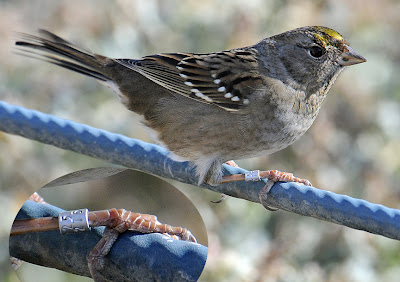
Back in October when I visited the Bay Area in California I was tickled to get some nice photo opportunities featuring Golden-crowned Sparrows. I don't get many chances at these (they rarely vagrate into Colorado) so seeing them and hearing their vocalizations was very cool. One that was perching cooperatively at the Palo Alto Baylands sported a band- sweet! As I was editing the pictures I realized that I could make out lots of numbers, so I enlisted the help of some bander friends of mine who knew their way around banding codes. From the various angles, they figured out that only the first number of each sequence was missing (?###-?####). With that information, there was a chance of figuring out the exact number (for example, the first number in the prefix was likely a 0, 1, or 2 based on the band size that Golden-crowned Sparrows take, and from that sequence, perhaps only one of the used band numbers in the 5-digit suffix was from a Golden-crowned Sparrow.) From there I chatted with a very helpful person at the USGS Patuxent Wildlife Research Center Bird Banding Lab (the national clearinghouse for bird banding information), who couldn't come up with a match at the time but promised to look into it. Look into it she did, and I got an email today that they were able to nail down the band number and the information on the bird, which I then formally submitted on the band reporting site. Turns out the bird was banded on 15 April 2008 within a few hundred meters of where I saw it on 10 October 2008. In the intervening months it migrated north, as Golden-crowned Sparrows breed near treeline in Brittish Columbia, Yukon, and Alaska. Then it came back again to its wintering territory at sea level on the southern San Fransisco Bay area- nice round trip and very tight site fidelity!

Sunday, December 07, 2008

Welcome Back!

I was tickled to hear from a friend that the light-morph Harlan's Hawk (harlani subspecies of Red-tailed Hawk) I found last year was back again on the same winter territory. I had looked along the row of power poles where I saw it last winter a few times without success, but yesterday I packed up my camera and good luck charm (my son Garrett) and we took the road less traveled on our way to do a few errands, cruising the strip south of Hygiene, Colorado, to see if the bird was there. Sure enough, it was on practically the same power pole as last year! When I snapped it last time, it was eating something, allowing me to get pretty close for posed pics but I never got anything good in the way of flight shot. This time it was kind of flighty, only allowing moderate-distance posed pics. But much to my delight, instead of flying away it flew along right past me. It wanted to stay on the power poles next to the road (probably waiting on rodents in the grassy strip between the road and a field beyond), and would shift three or four poles south each time it flew, allowing me to repeat the photo opportunity several times (I stayed in the car and shot from the shoulder of the road.) Not only that, but the magic combination of sunshine and snow on the ground really lit up the bird nicely. Rare bird, flying close by, in about perfect light- priceless! In my last post about the bird, my buddy Jeff Bouton said he hoped for continued reports and more images. Here you go, amigo- better late then never!